Recommending an Oncologist to Your Patient: How the ACE Framework Can Help
Telling a patient that she has or may have cancer can be one of the most challenging tasks a physician faces. And what typically follows
HIPAA Alert: Potential Data Breach Learn More
Questions on Oncology, Hematology and/or Infusion Clinical Services due to COVID-19 Crisis – CALL 833-698-1623
Important Information for Our Patients Regarding the Coronavirus.
RCCA Providing Area Cancer Patients with Access to Care During Coronavirus Outbreak
RCCA Offering Patients Virtual Visits During Coronavirus Pandemic
“Unfortunately, your cancer has returned.”
It’s news that anyone who has been treated for the disease dreads hearing.
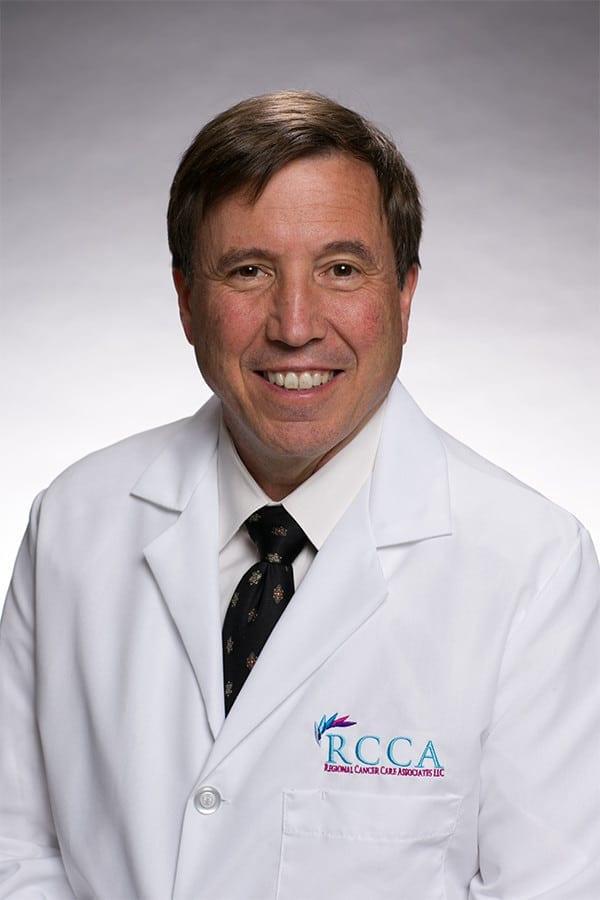
And it’s news that far fewer people with advanced melanoma will be hearing thanks to groundbreaking work by an international team of researchers that includes Andrew Pecora, MD, FACP, CPE, founder of Regional Cancer Care Associates (RCCA). RCCA is a group of more than 90 medical oncologists and hematologists who treat patients who have solid tumors, blood-based cancers, and benign blood disorders at more than 20 locations near you throughout New Jersey, Connecticut, and Massachusetts.
Dr. Pecora and colleagues at leading cancer centers around the world conducted the KEYNOTE-942 study, which involved 157 people who had undergone surgery to remove advanced-stage skin cancers that had a high likelihood of recurrence. Fifty of those people were treated with pembrolizumab (Keytruda®), an immunotherapy approved for the treatment of melanoma, non-small cell lung cancer, cervical cancer, and other solid tumors. The other 107 people received a combination of pembrolizumab and an investigational agent known as intismeran autogene.
A long-time pioneer in the development of immunotherapies, Dr. Pecora explains,
“Intismeran autogene represents the latest frontier in efforts to harness the power of the patient’s immune system to detect and attack cancer cells.” He explains that the therapy is an individualized treatment that physicians customize for each patient by analyzing tissue and blood samples to map genetic mutations unique to the person’s cancer cells. Using artificial intelligence, scientists then identify specific abnormal proteins, known as neoantigens, capable of triggering an immune response. Genetic instructions for the neoantigens are inserted into an mRNA molecule and the therapy then is administered to the patient via intramuscular injection. The therapy prompts cells to biochemically “display” the neoantigen proteins, enabling specialized immune system cells known as T cells to find and attack cancer cells that have the same mutations.
Dr. Pecora says that while the science may be complex, the impact on patients is clear-cut. “After five years of follow-up, the combination therapy reduced the risk of recurrence by 49% compared to treatment with pembrolizumab alone,” he explains. The board-certified medical oncologist and hematologist continues, “Study participants had either stage IIIb or stage IV melanoma. In these later-stage skin cancers, the rate of post-surgical recurrence can range from 40% to upwards of 90%, so a treatment that can cut the 5-year risk of recurrence in half represents a significant advance against a disease that is expected to claim more than 8,500 lives in the United States this year.”
Beyond establishing the efficacy of intismeran autogene plus pembrolizumab, the KEYNOTE-942 reaffirmed the safety profile that the combination demonstrated in earlier research. While all patients in the intismeran plus pembrolizumab group had at least one side effect, as compared to 84% of people in the pembrolizumab group, most of those events were low-grade and self-limited. No patient receiving the combination therapy had a Grade 4 or 5 adverse event, the medical terminology for severe side effects.
Reflecting its significance in the fight against melanoma, the KEYNOTE-942 trial was one of the marquee studies featured at the annual meeting of the American Society of Clinical Oncology in Chicago this June.
Dr. Pecora explains that he and the Sarcoma, Connective Tissue, and Cutaneous (Skin) Medical Oncology team at the John Theurer Cancer Center (JTCC) of Hackensack University Medical Center in Hackensack, NJ, already are at work on the Phase III trial needed to secure Food and Drug Administration (FDA) approval of the combination regimen.
That study will be the latest of hundreds that Dr. Pecora has conducted since beginning his cancer research career as a medical oncology-hematology fellow at Memorial Sloan-Kettering Cancer Center. After several years at that renowned Manhattan center, the North Jersey native came to what was then known as Hackensack Hospital in 1993 to launch the institution’s stem cell transplantation program. Since then, he has served as chairman of JTCC, the medical center’s President of Physician Enterprise and Chief Innovations Officer and, currently, Senior Scientist for the medical center’s Institute for Biomedical Research. In addition, he is Professor of Medicine and Oncology at Georgetown University School of Medicine and the founder of several healthcare companies. Dr. Pecora also continues to practice with RCCA, which he founded in 2012 by guiding the merger of 10 separate oncology practices.
“Although I recognized the potential of immunotherapy at the start of my career and made it the focus of my research and clinical practice, I couldn’t have fully imagined the gains we have made with this treatment modality and other cancer therapies. The pace of innovation and the improved outcomes we are achieving, particularly in the last few years, have been incredible, and I am even more excited today than I was 30 years ago about what the future will hold,” Dr. Pecora says.
Dr. Pecora is one of more than 90 medical oncologists and hematologists who practice with Regional Cancer Care Associates (RCCA), one of the nation’s largest networks of oncology specialists. RCCA has more than 20 locations near you across New Jersey, Connecticut, and Massachusetts. RCCA’s cancer specialists see more than 30,000 new patients each year and provide care to more than 265,000 established patients, collaborating closely with those patients’ other physicians. RCCA physicians offer patients innovative therapies, including immunotherapies and targeted therapy, as well as access to approximately 300 clinical trials. In addition to serving patients who have solid tumors, blood-based cancers, and benign blood disorders, RCCA care centers also provide infusion therapy services to people with a number of non-oncologic conditions—including multiple sclerosis, Crohn’s disease, asthma, iron-deficiency anemia, and rheumatoid arthritis—who take intravenously-administered medications.
To learn more about RCCA, call 844-346-7222 or contact RCCA.
Khattak A, Carlino MS, Meniawy T, et al. Intismeran autogene plus pembrolizumab versus pembrolizumab alone in high-risk resected melanoma: 5-year update of the randomized Phase IIb KEYNOTE-942 study. J Clin Oncol. 2026;44(26):2482-2489.
National Cancer Institute. Cancer Stat Facts: Melanoma of the skin. Available at https://seer.cancer.gov/statfacts/html/melan.html. Accessed September 15, 2026.
Tarhini AA, Castellano E, Eljilany I. Treatment of stage III resectable melanoma – adjuvant and neovadjuvant approaches. Cancer J. 2024;30(2):54-70.

For more information or to schedule an appointment,
call 844-346-7222. You can also schedule an appointment by calling the RCCA location nearest you.

Telling a patient that she has or may have cancer can be one of the most challenging tasks a physician faces. And what typically follows

Mantle cell lymphoma is a rare and aggressive form of non-Hodgkin lymphoma. It spreads quickly to new organs and is often diagnosed at a later

Radiation therapy is one of the most common treatments provided to patients with cancer. This treatment uses high-energy beams or radiation “seeds” to kill cancer
Regional Cancer Care Associates is one of fewer than 200 medical practices in the country selected to participate in the Oncology Care Model (OCM); a recent Medicare initiative aimed at improving care coordination and access to and quality of care for Medicare beneficiaries undergoing chemotherapy treatment.