

HIPAA Alert: Potential Data Breach Learn More

Search
Close this search box.

Prostatic Sarcomatoid Carcinoma Treatment Near You in NJ, CT, MA, and the Washington, D.C. area

Prostate cancer is among the most common cancer types, affecting up to 12% of men. Although common, prostate cancer includes many rare subtypes that occur in a small fraction of patients. These rare forms of prostate cancer present unique challenges for treatment and require care from a knowledgeable oncologist.

Regional Cancer Care Associates (RCCA) is one of the nation’s largest oncology networks, with more than 20 locations near you in New Jersey, Connecticut, Massachusetts, and the Washington, D.C., area. We treat a wide range of cancer types, including breast, lung, skin, and prostate cancers, in addition to blood disorders. Our physicians’ experience and expertise extends to management of rare malignant conditions, like sarcomatoid prostate cancer.

What Is Prostatic Sarcomatoid Carcinoma?

Cancer develops when normal cells mutate and grow uncontrollably. Cancer types are categorized based on the type of tissue in which the mutation originates. Carcinomas, for example, arise from the epithelial tissue that lines most organs. Sarcomas, meanwhile, form from connective tissue.

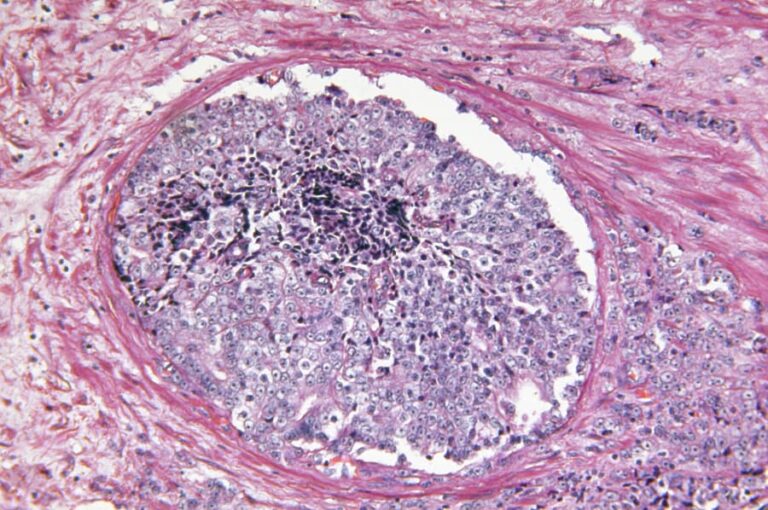
Prostatic sarcomatoid carcinoma, also called prostate carcinosarcoma, is a carcinoma that resembles a sarcoma. It involves both epithelial and spindle cells. Spindle cells are a type of connective tissue that forms near damaged tissue. Normally, as the injured tissue heals, the spindle cells are gradually replaced by normal cells. in spindle cell cancers, however, the connective-tissue cells grow out of control.

In many cases, prostatic sarcomatoid carcinoma begins as prostatic acinar adenocarcinoma, the most common type of prostate cancer. The cancerous mutation causes cells to “de-differentiate.” That is, they become more generic in appearance and function and less like the glandular cells they started as. The de-differentiated cells take on the appearance of spindle cells. Because de-differentiated cells can proliferate quickly, sarcomatoid carcinomas are highly aggressive and have a fast rate of spread.

Phlebotomist holding blood sample labeled PSA test

Stages of Sarcomatoid Prostate Cancer

Cancer staging is a way for oncologists to describe how advanced the cancer is. For prostate cancer, this system is based on the tumor’s size, its degree of mutation, its rate of spread, and how it has affected prostate-specific antigen (PSA) levels. Sarcomatoid prostate cancer is staged by the same system used for other prostate cancer types:

  • Stage I: The tumor is located only in the prostate and cannot be felt during a rectal exam. PSA levels are below 20 ng/mL.
  • Stage II: The tumor is located only in the prostate gland and may be large enough to detect with a rectal exam. PSA levels measure between 10 and 20 ng/mL.
  • Stage III: The tumor has spread outside the walls of the prostate gland and may have invaded one or both seminal vesicles. PSA levels are above 20 ng/mL.
  • Stage IV: Cancer cells have spread (metastasized) to nearby lymph nodes and distant parts of the body. PSA levels may have any reading.

Patient survival is best when treatment begins in the early stages. As cancer continues to grow and metastasize, the five-year survival rate drops significantly. This is why early cancer detection is so important.

Signs and Symptoms of Prostatic Sarcomatoid Carcinoma

Symptoms of prostatic sarcomatoid carcinoma are similar to those associated with other prostate cancers. They often do not appear until later stages of the disease, when the growing tumor puts pressure on the prostate gland and nearby structures. Common symptoms include:

  • Frequent or urgent need to urinate
  • Slow, interrupted, or inconsistent urine
  • Needing to strain during urination
  • Loss of bladder control
  • Pain during urination or ejaculation
  • Blood in urine or semen
  • Erectile dysfunction
  • Rectal pain or pressure

As cancer spreads to other parts of the body, it may cause new symptoms. Late-stage cancer may cause bone pain, nerve dysfunction, fatigue, loss of appetite, and unexplained rapid weight loss.

Diagnostic Tests for Prostatic Sarcomatoid Carcinoma

Lack of symptoms can make early-stage sarcomatoid carcinomas difficult to identify. For this reason, medical oncologists recommend routine PSA screening to detect prostate cancer before symptoms develop. After an abnormal screening, the following tests are used to confirm a diagnosis:

Digital Rectal Exam

A digital rectal exam (DRE) is a type of physical exam used to check for lumps on the prostate. To perform it, the physician inserts a gloved, lubricated finger into the rectum. The finger is used to feel for lumps, hard masses, or other signs of a tumor.

Medical Imaging

Medical imaging is another means of locating tumors. This approach uses computed tomography (CT) scans, magnetic resonance imaging (MRI) scans, ultrasound or similar imaging technologies to take pictures of the inside of the prostate. The pictures can then be examined for tissue abnormalities.

Prostate Biopsy

Prostate cancer diagnoses are confirmed with a biopsy. This test involves removing small amounts of tissue from the prostate using a hollow needle. The samples are evaluated under a microscope to determine whether cancer is present and — if cancer is present — to identify its type.

Treatments for Prostatic Sarcomatoid Carcinoma

Prostatic sarcomatoid carcinoma is an aggressive cancer that is often diagnosed in its later stages. For this reason, prompt treatment is often recommended. Patients meet with their oncologist to discuss different options and the benefits and downsides of each. RCCA oncologists prioritize targeted therapies whenever appropriate. Other treatment options include:

Find Sarcomatoid Prostate Cancer Treatment Near You in NJ, CT, MA, and the Washington, D.C., Area

Although sarcomatoid prostate cancer is rare and aggressive, effective treatments are available. The medical oncologists and hematologists of Regional Cancer Care Associates employ cutting-edge methods to treat a wide range of cancers and blood disorders, including rare and unusual diagnoses. We serve patients at more than 20 locations near you in New Jersey, Connecticut, Massachusetts, and the Washington, D.C., area. Contact us to learn more or to schedule a consultation with a medical oncologist.

Frequently Asked Questions About Sarcomatoid Prostate Cancer

What is sarcomatoid prostate cancer?

Prostatic sarcomatoid carcinoma is a rare type of prostate cancer. It initially develops in the prostate gland as a standard adenocarcinoma. Over time, however, it develops spindle cells that resemble those found in prostate sarcomas.

What are the signs of prostatic sarcomatoid carcinoma?

Like other prostate cancers, sarcomatoid prostate cancer often shows no symptoms in its early stages. Late-stage signs include urinary and sexual pain or dysfunction.

How is sarcomatoid prostate cancer detected?

Most cases of sarcomatoid prostate cancer are detected with a prostate-specific antigen (PSA) blood test. After an abnormal screening, physicians use a combination of digital rectal examination (DRE), medical imaging, and a prostate biopsy to confirm the diagnosis.

What are the main risk factors for prostate cancer?

The biggest risk factors for prostate cancer are:

  • Age over 50 years
  • African American or Caribbean racial heritage
  • Family history of prostate cancer

What are the treatments for prostate cancer?

RCCA offers a range of treatment options for prostate cancer, including active surveillance, surgery, radiation therapy, hormone therapy, targeted therapy, immunotherapy, and chemotherapy. Treatment plans are personalized to accommodate each patient’s unique case.

Treatment Options at RCCA

No matter which type of prostate cancer you or a loved one has been diagnosed with, Regional Cancer Care Associates is there to fight the battle with you. Our team of experts will determine the best combination of the most advanced treatments and methods, which can include chemotherapy, radiation, hormone therapy or surgery, to help you achieve the best possible outcome. For more information or to find an RCCA location near you, contact us today at 844-346-7222.

RELATED ARTICLES

Regional Cancer Care Associates is one of fewer than 200 medical practices in the country selected to participate in the Oncology Care Model (OCM); a recent Medicare initiative aimed at improving care coordination and access to and quality of care for Medicare beneficiaries undergoing chemotherapy treatment.