

HIPAA Alert: Potential Data Breach Learn More

Search
Close this search box.

Prostate Sarcoma Treatment Near You in NJ, CT, MA, and the Washington, D.C., Area

Prostate sarcoma is a rare and highly aggressive form of prostate cancer.

The medical oncologists of Regional Cancer Care Associates (RCCA), one of the largest oncology networks in the country, have experience and expertise in treating both common and rare forms of prostate cancer, other solid tumors, and malignant and benign blood disorders. Our services are available at more than 20 locations in New Jersey, Connecticut, Massachusetts, and the Washington, D.C. area, enabling patients to receive cutting-edge care close to home.

What Is Prostate Sarcoma?

Sarcomas are rare cancers that originate in connective and supportive tissue. There are many types of sarcomas, with each characterized by where in the body it first develops. Sarcomas in the mesenchymal (smooth muscle) cells of the prostate are known as prostate sarcomas.

Cancers are caused by abnormal cell growth. Normally, cells in the body reproduce by dividing at a consistent rate to replace others that die. Certain DNA mutations, however, alter the instructions that tell cells when to divide. This change causes cells to multiply without regulation. The mutated cell mass, called a tumor, grows and begins to crowd out healthy tissue. The mutation may also invade nearby tissues or spread further by traveling through the blood stream or lymphatic system.

Prostate sarcomas account for less than 1% of all prostate cancers. They are also aggressive, with a high likelihood of invading other tissues. Prompt diagnosis and treatment are essential. Because prostate sarcomas form from smooth muscle tissue rather than glandular tissue, they require a different treatment approach than that employed for more-common prostate adenocarcinomas that arise from glandular cells. This factor, in combination with sarcoma’s aggressive spread, can present a challenge when planning treatment.

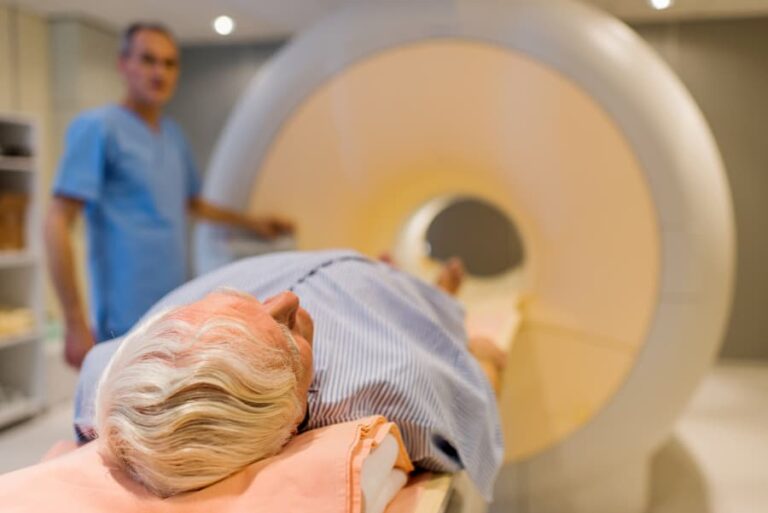
Patient preparing for MRI to screen for prostate sarcoma

Stages of Prostate Sarcoma

Oncologists use an approach called staging to characterize a cancer and decide how best to treat it. With prostate sarcomas, staging is based on the tumor size, its grade (how abnormal cancer the cells look under a microscope), and whether it has metastasized (spread) to other tissues. In summary:

  • Stage I: The tumor is up to 15 centimeters in size. Cancer cells are grade 1 or cannot be assessed.
  • Stage II: The tumor is up to 15 centimeters. Cancer cells are grade 2 or 3 (medium grade).
  • Stage III: The tumor is larger than 10 centimeters and may exceed 15 centimeters. Cancer cells are grade 2 or 3 (medium grade).
  • Stage IV: Cancer cells have spread to lymph nodes or more distant parts of the body. Cancer cells may be of any grade.

As with any cancer, the outlook for prostate carcinoma is best when the disease is identified and treated in its early stages. Prostate sarcoma that has not metastasized (spread) has a five-year survival rate of 81%. Once the cancer spreads, however, the five-year survival rate drops to 15%.

Signs and Symptoms of Prostate Sarcoma

Prostate sarcomas do not always cause symptoms early on. Symptoms develop as the tumor grows, putting pressure on the prostate gland and nearby tissues. Common signs of prostate sarcoma include:

  • Frequent or urgent need to urinate
  • Slow, interrupted, or inconsistent urine
  • Needing to strain during urination
  • Loss of bladder control
  • Pain during urination or ejaculation
  • Blood in urine or semen
  • Erectile dysfunction
  • Rectal pain or pressure

Late-stage prostate sarcoma may cause symptoms in other areas of the body, as well, with those issues caused by new tumors forming in lymph nodes and distant organs. Symptoms of metastatic prostate sarcoma may include bone pain, nerve dysfunction, fatigue, loss of appetite, and unexplained rapid weight loss.

Diagnostic Tests for Prostate Sarcoma

Prostate sarcoma can be difficult to diagnose. As noted, early-stage prostate cancers do not always cause symptoms. Further, sarcomas do not cause changes in blood levels of a protein, prostate-specific antigen (PSA), that can signal the possible presence of other, more common forms of prostate cancer during screening performed as part of a routine wellness examination. Most prostate sarcomas are detected through the following tests:

Digital Rectal Exam

A digital rectal exam (DRE) is a physical examination of the prostate. The physician inserts a gloved, lubricated finger into the rectum, using it to feel for hard lumps or masses that may indicate a tumor. This test cannot always detect cancer in its early stages, when tumors are often small.

Medical Imaging

Medical imaging tests include computed tomography (CT) scans, magnetic resonance imaging (MRI) scans, and ultrasounds, which produce images of the inside of the body. They can be used to look for abnormal tissue masses and other signs of a prostate tumor.

Prostate Biopsy

Prostate cancer diagnoses are confirmed with a biopsy. This test involves using a hollow needle to remove a small amount of tissue from the prostate. The tissue is examined under a microscope to determine whether cancer is present and – if so – to identify its characteristics.

Treatments for Prostate Sarcoma

Because prostate sarcoma typically spreads aggressively, and because it can be difficult to detect until late stages, prompt treatment is often advised. Oncologists weigh a variety of factors when determining the right approach, including the cancer’s stage and the patient’s overall health condition. Options include:

  • Surgery: Early-stage sarcomas are marked by small tumors that may be removed with surgery alone.
  • Radiation therapy: This treatment kills cancer cells with high-energy beams of radiation. It may be used to shrink tumors before surgery or to kill cells that are left behind afterward.
  • Immunotherapy: This treatment empowers the patient’s immune system to fight cancer.
  • Chemotherapy: This approach kills cancer cells using strong drugs and can be effective at killing or controlling cancer that has spread beyond the prostate.
  • Targeted therapy: This treatment attacks cells that have certain proteins or characteristics unique to prostate sarcomas.

While these treatments are effective for early-stage cancer, Stage IV prostate sarcoma cannot be cured. Instead, RCCA focuses on extending survival and improving quality of life through palliative care.

Find Prostate Cancer Treatment Near You in NJ, CT, MA, and the Washington, D.C. Area

Patients with prostate sarcoma are not alone. They can find comprehensive support and treatment at Regional Cancer Care Associates, a network of oncologists and hematologists practicing at more than 20 locations near you in New Jersey, Connecticut, Massachusetts, and the Washington, D.C., area. We deliver state-of-the-art care to help patients achieve the best possible outcomes. Contact us to learn more or schedule a consultation.

Frequently Asked Questions About Prostate Sarcoma

What is a prostate sarcoma?

Prostate sarcoma is a rare and fast-growing cancer that forms in the smooth muscle tissue surrounding the prostate.

What are the signs and symptoms of prostate sarcoma?

Prostate cancer often does not cause symptoms in the early stages. As the cancer grows, it may cause dysfunction with urination and ejaculation, among other symptoms.

When should men start getting screened for prostate cancer?

Screening is typically recommended starting at age 50 years, or earlier for those at high risk (such as African American men or those with a family history of prostate cancer).

How is prostate sarcoma detected?

While most types of prostate cancer are first detected with a prostate-specific antigen (PSA) blood test, this method does not work with sarcomas. Instead, physicians employ a combination of digital rectal exams, medical imaging, and a prostate biopsy.

What are the treatments for prostate sarcoma?

The best treatment for prostate sarcoma depends on the cancer’s stage. Options include surgery, radiation therapy, hormone therapy, immunotherapy, and chemotherapy. RCCA also gives patients access to clinical trials for the most recent advances in cancer care.

Treatment Options at RCCA

No matter which type of prostate cancer you or a loved one has been diagnosed with, Regional Cancer Care Associates is there to fight the battle with you. Our team of experts will determine the best combination of the most advanced treatments and methods, which can include chemotherapy, radiation, hormone therapy or surgery, to help you achieve the best possible outcome. For more information or to find an RCCA location near you, contact us today at 844-346-7222.

RELATED ARTICLES

Regional Cancer Care Associates is one of fewer than 200 medical practices in the country selected to participate in the Oncology Care Model (OCM); a recent Medicare initiative aimed at improving care coordination and access to and quality of care for Medicare beneficiaries undergoing chemotherapy treatment.