
HIPAA Alert: Potential Data Breach Learn More
Questions on Oncology, Hematology and/or Infusion Clinical Services due to COVID-19 Crisis – CALL 833-698-1623
Important Information for Our Patients Regarding the Coronavirus.
RCCA Providing Area Cancer Patients with Access to Care During Coronavirus Outbreak
RCCA Offering Patients Virtual Visits During Coronavirus Pandemic
While all lung cancers start in the lungs, they do not all behave identically. Each type of lung cancer forms from different tissue and responds differently to treatment. Regional Cancer Care Associates (RCCA) is one of the nation’s largest networks of oncology specialists, serving patients in New Jersey, Connecticut, Massachusetts, and the Washington, D.C., area. We provide care for all types of lung cancer, including squamous cell carcinoma lung cancer, making use of cutting-edge technology and treatments.
The lungs are organs in the chest that are responsible for respiration. When a person inhales, air enters through the mouth or nose and moves into the larynx (voice box). It then passes down the trachea (windpipe) before splitting down two paths called bronchial tubes. Each person has two bronchial tubes, one to access each lung. The tubes split again into bronchi, then again into bronchioles, becoming progressively narrower and more numerous until they end in round sacs called alveoli. These sacs are where the transfer of gases takes place. Oxygen is absorbed, and carbon dioxide is discarded.
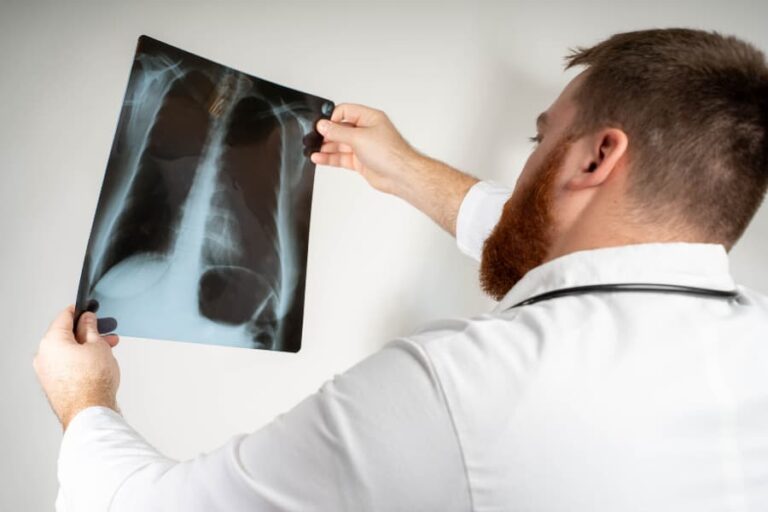
Squamous cell carcinoma of the lung is a subtype of non-small cell lung cancer (NSCLC) that forms from squamous cells. These are thin, flat cells that line the airways of the lungs, creating a protective barrier between inhaled air and the more vulnerable lung tissues. When squamous cells turn cancerous, they start to divide and reproduce rapidly, creating a tumorous mass of abnormal tissue.
Squamous cell carcinoma is one of the more common types of lung cancer, accounting for 25% to 35% of all lung cancers, and is the most common type found in smokers. It is extremely rare in non-smokers. Squamous cell carcinoma is likely to develop in the center of the lungs, especially the bronchi, unlike other types that develop near the edges of the lungs.
All NSCLCs, including squamous cell carcinoma, are staged using the TNM system. Developed by the American Joint Committee on Cancer (AJCC), this system provides a standardized way to describe how cancers progress. It weighs three factors: the size of the tumor (T), the involvement of lymph nodes (N), and the degree of metastasis (M), meaning spread, into other tissues and organs. After assigning a value to each of these factors, the cancer is categorized into one of four stage groupings:
Each stage includes multiple substage groupings based on individual T, N, and M values. These provide physicians with more precise information about the cancer’s progress. This system can be complicated, and patients should not hesitate to ask for help understanding their diagnosis.
Tobacco smoking is the most common risk factor for lung cancer. Smoking introduces cancer-causing substances, known formally as carcinogens, into the lungs, damaging cell DNA and causing genetic mutations that may lead to cancer. Squamous cells line the airways in the lungs, making them extremely vulnerable to inhaled carcinogens. Almost all cases of squamous cell carcinoma of the lung are related to smoking. Less commonly, squamous cell cancer may develop due to other harmful exposures, such as:
People may also be at increased risk of squamous cell carcinoma if they have a strong family history of lung cancer or other types of cancer. However, when compared with exposure-based causes, family history is a relatively minor risk factor.
Many patients with lung cancer do not experience symptoms in the early stages of the disease. Symptoms appear as the cancer progresses and moves deeper into the lung. While squamous cell carcinoma follows this pattern, it is more likely to display symptoms earlier than other lung cancers. It shares several signs and symptoms with other lung cancers, including:
These symptoms can be similar to those of other, non-cancerous lung conditions. Many patients assume that they have a less-serious disease, causing them to delay treatment. All persistent lung conditions can be serious. If you are experiencing any of the above signs, it is important to seek medical attention as soon as possible. The sooner treatment begins, the more effective it will be.
Lung cancer care begins with a diagnosis. Physicians perform a series of tests to determine whether the patient’s symptoms are caused by lung cancer. The tests also can provide information about the patient’s cancer, including its type, location, and stage. Diagnostic tests include:
Most lung cancer diagnosis begins with a chest X-ray to look for signs of abnormal tissue in the lungs. If any suspicious tissues are seen, a follow-up computed tomography (CT) scan creates cross-sectional images of the lung for more detailed analysis. A positron emission tomography (PET) may also be requested. This test checks for increased metabolic activity and may identify areas where cancer is spreading.
If cancer is found in a main airway, it may be examined via bronchoscopy. This test uses a long, narrow tube with a tiny camera mounted on the end. The tube is guided up and down the patient’s airways, providing a live video feed of the larynx, trachea, and bronchi. An endobronchial ultrasound (EBUS) may be performed simultaneously to check for abnormalities in the lymph nodes.
Sputum cytology is a non-invasive test that can sometimes confirm the presence of cancer. This test requires a sample of sputum, or phlegm from coughing. The sample is examined under a microscope to check for cancer cells that may have broken off from the tumor while coughing. Sputum cytology is particularly useful for diagnosing squamous cell carcinoma due to that cancer’s usual location in the lung.
Lung cancer diagnosis concludes with a lung biopsy. During this test, a physician removes a small amount of tissue or fluid from the abnormal mass in the lung. The sample may be obtained in a few different ways:
The biopsy sample is examined under a microscope to look for cancer cells. The results confirm whether cancer is present and identify what type of cancer it is.
Tissue samples from a lung biopsy may also be used for molecular testing. This test is performed at a medical laboratory to learn more about specific genetic mutations, proteins, and other identifying characteristics called biomarkers. Certain biomarkers tell oncologists whether the cancer will respond well to treatments such as targeted therapy or immunotherapy.
The goal for early- to mid-stage lung cancer treatment is to put the cancer into remission. This means that the cancer is shrinking and its symptoms are reduced or absent. Most treatment plans employ a variety of strategies to maximize their chances of success. Some methods that may be used include:
Surgery is the preferred treatment for squamous cell carcinoma that has not spread outside the lungs. The surgeon resects or removes the tumor, some of the surrounding tissue, and a few lymph nodes, if necessary. There are a few types of lung cancer surgery:
Surgery may be followed by other treatments to kill any cancer cells that remain.
Radiation therapy uses a focused beam of radiation to kill cancer cells. It is often used to shrink the tumor before surgery, making it easier to resect. It may also be used after surgery to destroy any cancer cells that may remain. Less often, radiation therapy is used as a substitute for surgery when an operation is deemed unsafe due to a patient’s age or overall health.
Chemotherapy uses strong drugs that are toxic to rapidly growing cells, like cancer cells. It can be administered intravenously or taken as an oral pill or fluid. Like radiation therapy, it is often used to shrink a tumor before surgery or to kill any remaining cancer cells afterward. It is also used for late-stage lung cancer, when it helps to control the cancer’s spread.
Immunotherapy modifies immune cells from the patient’s body, “training” them to fight cancer. It is most often used to control the growth of Stage III lung cancer, to prevent or slow metastasis.
Stage IV lung cancer is not curable. At this stage, the cancer has spread to distant parts of the body and is impossible to eliminate. Treatment plans for patients with Stage IV squamous cell carcinoma aim to extend the patient’s life, slow the cancer’s spread, and reduce the patient’s symptoms. Chemotherapy, immunotherapy, and targeted therapy are often used to treat Stage IV squamous cell carcinoma ling cancer.
Systemic treatments frequently are delivered alongside palliative care. This is a care approach that focuses on improving the patient’s quality of life through counseling, nutritional support, social groups, and more. It may also include end-of-life planning.
Squamous cell carcinoma lung cancer can be a frightening diagnosis. With prompt treatment, however, patients can achieve the best possible outcomes. The medical oncologists of Regional Cancer Care Associates (RCCA) treat cancer at more than 20 locations near you in New Jersey, Connecticut, Massachusetts, and the Washington, D.C., area, enabling patients to receive care close to home. Contact us today to learn more or to schedule an appointment with an oncologist.
What are the early signs of lung cancer?
Early signs of lung cancer include coughing, wheezing, bloody phlegm, shortness of breath, fatigue, and unexplained weight loss. However, many cases do not cause symptoms in the early stages.
What are the main risk factors for lung cancer?
Tobacco smoking is the primary risk factor for lung cancer, especially squamous cell carcinoma. Air pollution, exposure to radon gas, and exposure to industrial chemicals are also risk factors.
Can non-smokers get lung cancer?
Yes, non-smokers can get lung cancer. While squamous cell carcinoma is almost always caused by smoking, other forms of lung cancer are more common in non-smokers.
What is the role of staging in lung cancer diagnosis?
The staging system describes how much a patient’s cancer has progressed. This information is used to plan the most appropriate treatment.