
HIPAA Alert: Potential Data Breach Learn More
Questions on Oncology, Hematology and/or Infusion Clinical Services due to COVID-19 Crisis – CALL 833-698-1623
Important Information for Our Patients Regarding the Coronavirus.
RCCA Providing Area Cancer Patients with Access to Care During Coronavirus Outbreak
RCCA Offering Patients Virtual Visits During Coronavirus Pandemic
Lung cancer is a diagnosis that encompasses multiple subtypes of cancer. To plan the most effective treatment, oncologists must first determine the type of lung cancer a patient has. Regional Cancer Care Associates (RCCA) serves patients in New Jersey, Connecticut, Massachusetts, and the Washington, D.C., area with state-of-the-art cancer care. Our oncologists treat all types of lung cancer, including adenocarcinoma lung cancer, to help patients achieve the best possible outcomes.
The lungs are a pair of organs in the chest that facilitate respiration, or the movement of gases in and out of the body. When a person inhales, air enters through the larynx (voice box) and passes down the trachea (windpipe). The trachea divides into bronchial tubes that lead to each lung. These tubes branch again into bronchi, then into bronchioles, before terminating in round sacs called alveoli. The alveoli are where oxygen is absorbed and carbon dioxide is discarded.
Adenocarcinoma of the lung is a type of non-small cell lung cancer (NSCLC) that develops in glandular cells. These cells line the lung’s narrow passages, such as the bronchioles and alveoli, where they secrete a thick mucus known as phlegm. This mucus acts as a protective layer that defends against external hazards, such as bacteria. When phlegm-producing cells become cancerous, they start dividing rapidly. The result is a growing mass of abnormal tissue called a tumor.
Lung adenocarcinoma is among the most common types of lung cancer. It accounts for about 40% of all lung cancers. It is also the type of lung cancer most likely to be diagnosed in younger people (those between the ages of 20 and 46) and people who have never smoked.
Like other cancers, lung adenocarcinoma is staged based on the TNM system. This system was developed by the American Joint Committee on Cancer (AJCC) as a standardized way to describe how much a cancer has progressed. It evaluates cancers based on the size of the tumor (T), the involvement of lymph nodes (N), and the degree of spread, or metastasis (M), to distant sites. The stages of lung cancer are:
The lung cancer stage often is further categorized by numbered ratings for each letter in the TNM abbreviation. These ratings provide physicians with additional information about the lung cancer’s presentation and progression. Staging of lung cancer can be complex, so patients should not hesitate to ask their physicians for an explanation they understand.
Lung cancer causes more deaths in the United States each year than any other form of cancer. The American Cancer Society estimates that 124,990 people across the country will die of the disease in 2026. Most of these deaths are due to adenocarcinomas of the lung. While not all cases can be prevented, understanding the risk factors for the disease may help people reduce their risk. Avoidable risk factors for lung cancer include:
Unavoidable risk factors include age and gender. Adenocarcinoma of the lung is more likely to affect women than men. It is more common in patients over the age of 45 than in younger people.
Lung cancer is most often diagnosed after a person notices symptoms. In many cases, however, there are no detectable symptoms while the cancer is in early stages. The person only experiences signs or symptoms after the cancer has spread. In some cases, people may think that their symptoms are caused by a less serious condition. This can lead to a delayed diagnosis and make treatment more challenging.
It is important for people to know the signs of lung cancer and when to speak with a doctor. Common symptoms include:
Adenocarcinoma of the lung shares symptoms with other types of lung cancer, and a person’s cancer type cannot be determined by symptoms alone. Therefore, if people are experiencing symptoms of a lung disease, they should seek medical attention as soon as possible.
Prompt diagnosis is one of the most crucial steps in treating adenocarcinoma of the lung. The less advanced the cancer is, the more responsive to treatment it likely will be. It is also important to diagnose the cancer accurately, as different types respond differently to various treatments. Lung cancer diagnosis is performed by oncologists, pulmonologists (lung doctors), radiologists, and pathologists, who use multiple techniques to provide a thorough evaluation. Diagnostic tests for lung cancer include:
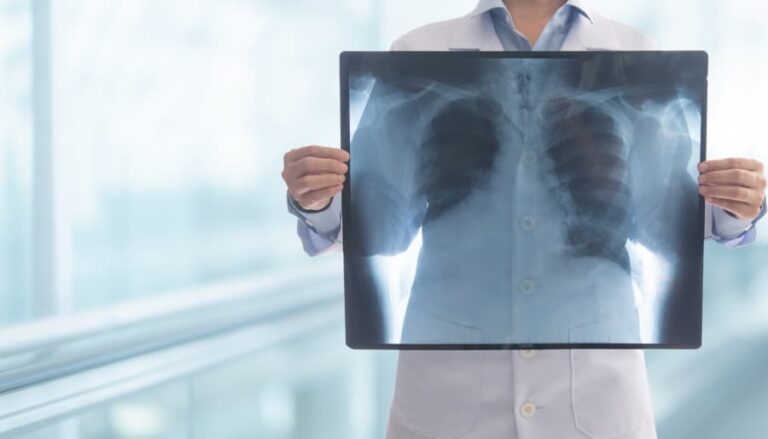
Medical imaging tests are non-invasive tests that create images of the inside of the body. Most evaluations for possible lung cancer evaluations begin with a chest X-ray to identify abnormalities, followed by a computed tomography (CT) scan for a more detailed analysis. A positron emission tomography (PET) may also be requested to look for increased metabolic activity, which may indicate that the cancer is spreading.
A bronchoscopy is an invasive test that uses a long, narrow tube to guide a tiny camera down the patient’s airways. This allows physicians to examine the bronchial tubes and bronchi directly to locate obstructions and areas of suspicious tissue. Bronchoscopy is also used to perform endobronchial ultrasound (EBUS), which uses sound waves to examine the lymph nodes for abnormalities.
If the patient is coughing up phlegm, sputum cytology may be ordered. A sample of phlegm is examined under a microscope to check for cancer cells. While sputum cytology cannot always detect cancers that are located in the outer parts of the lungs, it can sometimes help to confirm the presence of cancer in major airways.
A lung biopsy is used to conclusively diagnose lung cancer. The test involves removing a small amount of lung tissue to examine it under a microscope. Samples can be taken in one of three ways:
After a biopsy confirms that cancer is present, the samples are tested on a molecular level to learn more about the cancer’s characteristics. Molecular testing looks for biomarkers, or specific genetic mutations or proteins, that help oncologists predict how the cancer will respond to treatment. They may indicate that the cancer is suitable for personalized treatments such as targeted therapy.
The goal when treating early-stage lung cancer is to cure the disease or send it into remission. Remission means that the cancer is shrinking and its symptoms have subsided or disappeared, although cancer cells may still be present in the body. Common treatment approaches include:
Surgery is the preferred treatment when adenocarcinoma is found only in the lungs. The surgeon removes the tumor and some of the surrounding tissue. There are a few types of lung cancer surgery, including:
Surgery may be followed by radiation therapy or chemotherapy to kill any cells that could not be removed, reducing the risk of a recurrence.
Radiation therapy uses high-energy beams to kill cancer cells or stop them from reproducing. It is often used to shrink a tumor before surgery or to eliminate cells that may remain after surgery. It is also sometimes used instead of surgery, especially if the patient cannot be safely operated on due to age, physical health, or other reasons.
Chemotherapy uses drugs that are extremely toxic to cells that divide rapidly, especially cancer cells. It can be delivered intravenously or taken orally. Like radiation therapy, chemotherapy is often part of a combined care plan. It can be used to shrink large tumors before surgery or to kill cancer cells that could not be surgically removed. It may also be used to control cancer that has spread outside the lungs.
Immunotherapy empowers the patient’s own immune system to fight cancer. A recent advancement, this approach is becoming increasingly prevalent in lung cancer treatment. It is most often used after chemotherapy or radiation therapy to help kill cancer cells that remain after surgery, especially if the cancer has started to metastasize.
When lung cancer reaches Stage IV, it is no longer curable. It is impossible to eliminate cancer that has spread throughout the whole body. Instead, the goal of treatment is to control the spread, prolong the patient’s life, and alleviate symptoms. The most common treatments are systemic therapies. Chemotherapy, immunotherapy, and targeted therapy are carried through the bloodstream to reach all parts of the body, giving them the best chance of controlling the cancer.
Systemic treatments are often combined with palliative care. This approach aims to improve the patient’s quality of life by relieving symptoms and reducing the impact of harsh treatments. It also includes emotional counseling, support groups, and end-of-life planning.
Adenocarcinoma lung cancer is the most common type of lung cancer and can be deadly. With an early diagnosis and access to cutting-edge care, however, patients can achieve a good outcome. Regional Cancer Care Associates offers treatment and clinical trials at more than 20 locations near you across New Jersey, Connecticut, Massachusetts, and the Washington, D.C., area. Contact RCCA today to learn more or to schedule an appointment.
What are the early signs of lung cancer?
Early signs of lung cancer include persistent coughing, bloody phlegm, chest pain, shortness of breath, fatigue or constant tiredness, and unexplained weight loss.
What are the main risk factors for lung cancer?
Tobacco smoking, air pollution, exposure to radon gas, and exposure to industrial chemicals are the most common causes of lung cancer.
Can non-smokers get lung cancer?
Yes, non-smokers can get lung cancer. Adenocarcinoma of the lung is the most common type of lung cancer found in non-smokers.
What is the role of staging in lung cancer diagnosis?
The staging system describes how much a patient’s cancer has progressed, which is crucial for planning an appropriate treatment.